
eQMA Distinguished Lecture – Spring 2026
High-Temperature Superconductivity – Insights from Einstein’s Electrons
Speaker: Zhi-Xun Shen, Stanford University
Wednesday
April 8, 2026
4:00–5:00pm
Brockman 101
Reception to follow
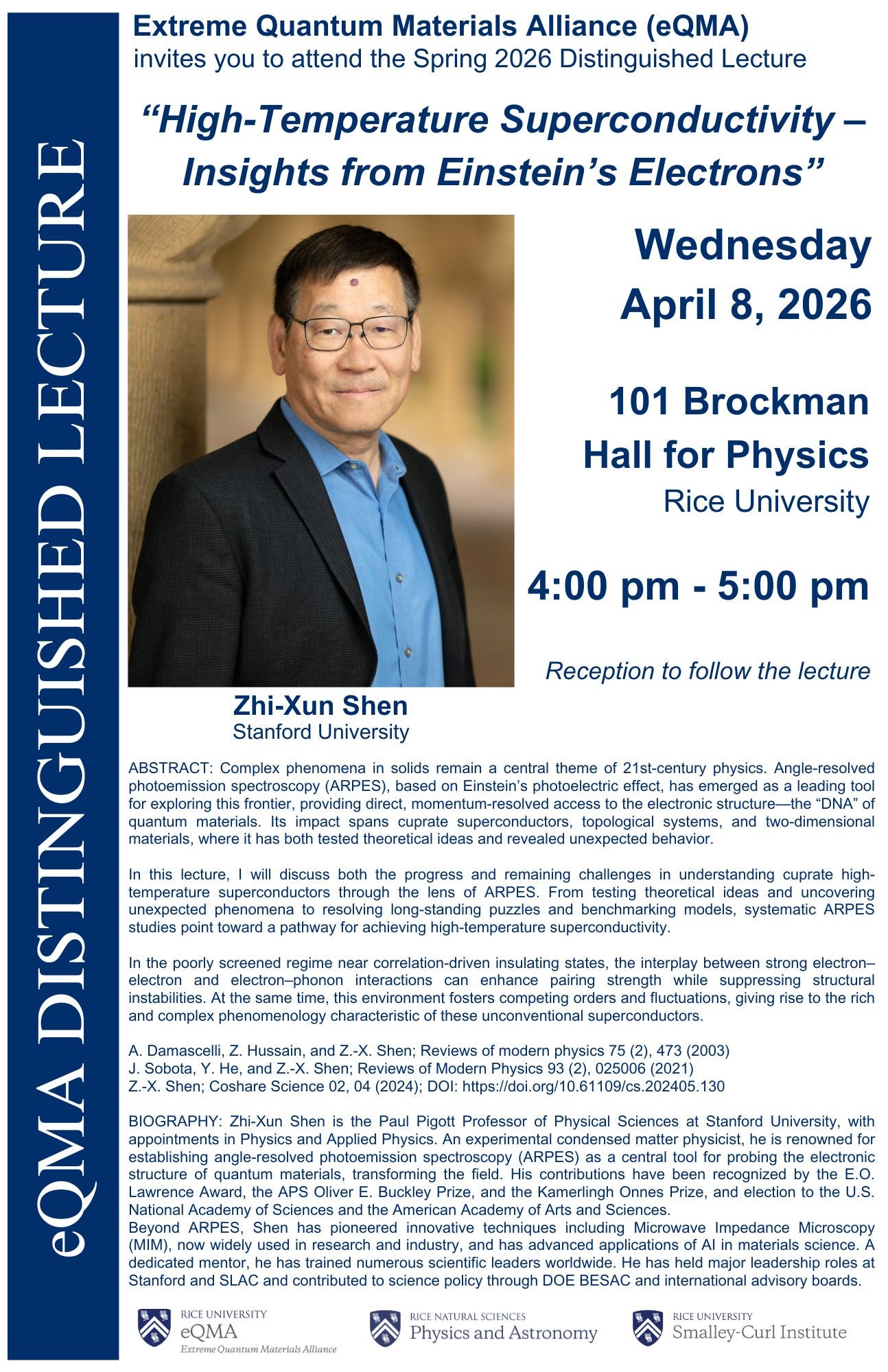
Speaker Bio
Zhi-Xun Shen is the Paul Pigott Professor of Physical Sciences at Stanford University, with appointments in Physics and Applied Physics. An experimental condensed matter physicist, he is renowned for establishing angle-resolved photoemission spectroscopy (ARPES) as a central tool for probing the electronic structure of quantum materials, transforming the field. His contributions have been recognized by the E.O. Lawrence Award, the APS Oliver E. Buckley Prize, and the Kamerlingh Onnes Prize, and election to the U.S. National Academy of Sciences and the American Academy of Arts and Sciences.
Beyond ARPES, Shen has pioneered innovative techniques including Microwave Impedance Microscopy (MIM), now widely used in research and industry, and has advanced applications of AI in materials science. A dedicated mentor, he has trained numerous scientific leaders worldwide. He has held major leadership roles at Stanford and SLAC and contributed to science policy through DOE BESAC and international advisory boards.
Abstract
Complex phenomena in solids remain a central theme of 21st-century physics. Angle-resolved photoemission spectroscopy (ARPES), based on Einstein’s photoelectric effect, has emerged as a leading tool for exploring this frontier, providing direct, momentum-resolved access to the electronic structure—the “DNA” of quantum materials. Its impact spans cuprate superconductors, topological systems, and two-dimensional materials, where it has both tested theoretical ideas and revealed unexpected behavior.
In this talk, I will discuss both the progress and remaining challenges in understanding cuprate high-temperature superconductors through the lens of ARPES. From testing theoretical ideas and uncovering unexpected phenomena to resolving long-standing puzzles and benchmarking models, systematic ARPES studies point toward a pathway for achieving high-temperature superconductivity.
In the poorly screened regime near correlation-driven insulating states, the interplay between strong electron–electron and electron–phonon interactions can enhance pairing strength while suppressing structural instabilities. At the same time, this environment fosters competing orders and fluctuations, giving rise to the rich and complex phenomenology characteristic of these unconventional superconductors.
A. Damascelli, Z. Hussain, and Z.-X. Shen; Reviews of modern physics 75 (2), 473 (2003)
J. Sobota, Y. He, and Z.-X. Shen; Reviews of Modern Physics 93 (2), 025006 (2021)
Z.-X. Shen; Coshare Science 02, 04 (2024); DOI: https://doi.org/10.61109/cs.202405.130